
Hair thinning in women is common and has several possible causes, from pattern thinning and hormonal changes to stress and tight hairstyles. A hair transplant can help when the thinning is stable and there is good donor hair to move. When the cause is unclear, a doctor will look for it before suggesting surgery.
This guide covers the common causes and the three Ludwig grades in plain words. It also explains how to style thinning hair in the meantime and when a transplant is worth exploring.
Why does women’s hair thin?
There is rarely a single answer, and more than one cause can overlap. In general terms, the most common are:
- Pattern thinning. It often runs in families. Hair on top gradually becomes finer and the parting widens, while the front hairline usually stays in place.
- Hormonal changes. Shifts after pregnancy, around menopause or with some health conditions can affect how hair grows.
- Stress or illness. A very stressful event or an illness can trigger a spell of heavier shedding a few months later. This often settles on its own.
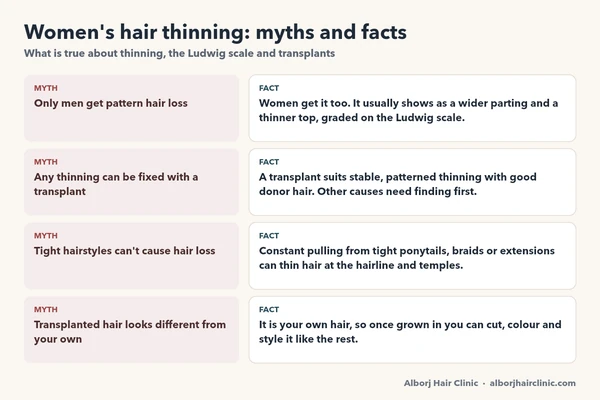
- Tight hairstyles. Tight ponytails, braids, buns and heavy extensions pull on the roots. Over time, that tension can thin the hair at the hairline and temples.
Diet, iron levels and thyroid health can also play a part. That is why a doctor may suggest tests before anything else.
What is the Ludwig scale?
The Ludwig scale is how doctors grade pattern thinning in women. Unlike the Norwood scale used for men, it focuses on the top of the head rather than a receding hairline. It has three grades:
- Grade I (mild). The parting looks a little wider and the top feels less full. Many women only notice it under bright light or when styling.
- Grade II (moderate). The parting is clearly wider, and more scalp shows through on top. Volume at the crown drops.
- Grade III (advanced). Hair on top is very thin, and the scalp is easy to see. The front hairline often still holds.
The grade helps a doctor judge how far thinning has gone and what may help. It is a guide, not a diagnosis on its own.
When should a doctor look for a cause first?
Not all thinning is pattern thinning. A doctor will usually want to understand the cause before discussing surgery if:
- The hair loss started suddenly or is getting worse quickly.
- Hair is coming out in patches.
- Thinning is spread across the whole scalp, including the back and sides.
- You have other symptoms, such as unusual tiredness or changes to your cycle.
- It began after a pregnancy, an illness or a very stressful period.
In these cases, a doctor may suggest other options first. Some types of shedding settle once the cause is dealt with, and a transplant would not address the underlying problem.
“With women, I always want to understand why the hair is thinning before we talk about a transplant. When the thinning is stable and the donor hair is good, a transplant can help. When it is not, the first step is finding the cause.”
How can you style thinning hair in the meantime?
While you find out what is going on, a few changes can make thinning less visible and kinder to your roots:
- Move your parting. A parting worn in one place for years tends to look wider. Shifting it slightly can add lift.
- Choose softer styles. Loose waves, low clips and soft scrunchies pull less than tight ponytails or slick buns.
- Try a layered cut. Shorter layers around the face and crown often add movement and make hair look fuller.
- Go easy on heat. Lower heat settings and fewer styling sessions help protect hair that is already fine.
If you wear extensions, ask your stylist whether your own hair can still carry their weight. On thinning hair, lighter or fewer pieces are usually gentler.
When can a hair transplant help?
In a transplant, healthy follicles are moved from the back and sides of the head to the thinner areas on top. It tends to suit women whose:
- Thinning is stable and follows a pattern, such as a widening parting.
- Donor hair is good, with enough density at the back and sides to move.
- Hair loss has a clear cause, such as pattern thinning, or hairline loss from tight styles that have since been dropped.
It is less likely to suit women whose thinning covers the whole scalp, because the donor area may be thinning too. A consultation checks this closely.
In DHI, the surgeon removes each follicle with a fine FUE punch, then places it into the thinning area with an implanter pen. Each graft holds about two to four hairs, and placing them by hand helps the surgeon work between existing hairs.
What is recovery like for women?
The procedure is carried out under local anaesthesia, and no stitches are needed. Patients usually describe it as mildly uncomfortable, with little or no pain.
Styling is usually the first question. Many clinics advise avoiding hair colour, heat styling and tight hairstyles until the scalp has healed, often for several weeks. These are typical ranges, so follow your own surgeon’s instructions.
Expect some shedding of the transplanted hairs in the first weeks, with new growth usually from around three months. The final result is visible at around 12 months. Your surrounding hair may still thin as you get older, which the surgeon takes into account when planning.
About Alborj Hair Clinic
Alborj Hair Clinic is a hair transplant clinic in Mazaya Centre, Al Wasl, Dubai. Its surgeon, Dr Dimitrios Ziakas, has 24 years of experience and has performed more than 4,000 hair transplant procedures. He is a member of the International Society of Hair Restoration Surgery (ISHRS) and uses the DHI (Direct Hair Implantation) technique.
More about the clinic and its approach is available at https://www.alborjhairclinic.com.
Women considering treatment can browse before-and-after case studies on the site to see how results build over a year.
Frequently asked questions
Can stress make your hair thin?
Yes. A stressful event or illness can trigger heavier shedding a few months later, which often settles once the trigger has passed. A doctor can check whether anything else is involved.
Is a widening parting a sign of pattern thinning?
It can be. A wider parting and less volume on top are typical early signs, but a doctor should confirm the cause.
Does the Ludwig grade decide whether I can have a transplant?
Not on its own. The surgeon also looks at the cause of the thinning, whether it is stable and how much good donor hair you have.
Can a transplant help with hair loss from tight hairstyles?
It can, once the tight styles have stopped and the thinning is stable. A surgeon will check your donor hair and whether the hairline needs treatment at all.