
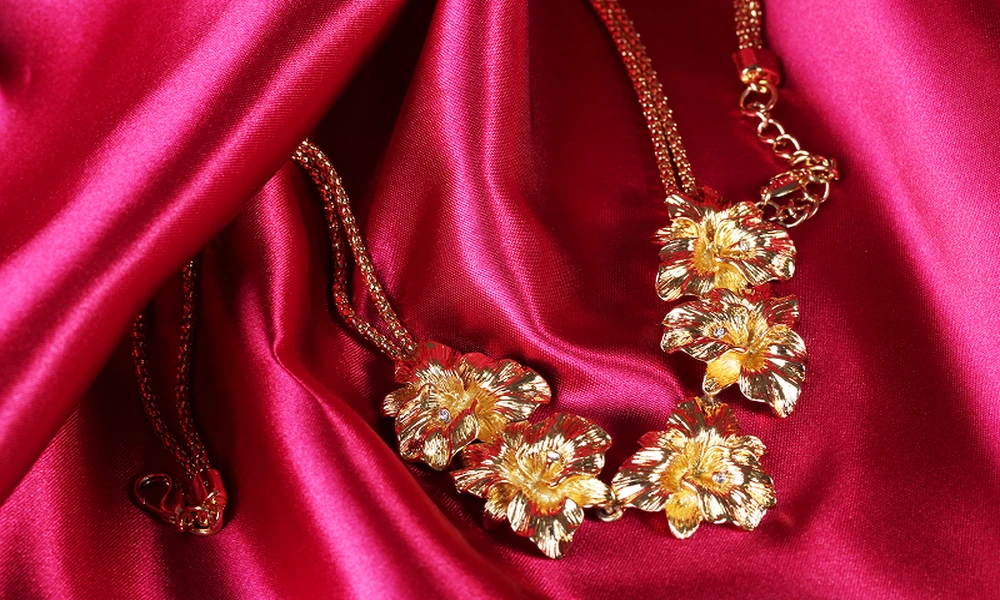
Image Recommendation: A Si Dian Jin gold jewellery set (necklace, bracelet, ring, earrings) laid out on red silk fabric, soft studio lighting.
The Chinese character for gold, 金, is shaped a little like a rooftop. That small visual detail is the reason an entire wedding tradition exists. When a groom’s mother presents Si Dian Jin to her future daughter-in-law, the gesture is quietly saying something specific: that the bride will always have a roof over her head in her new family.
Most people who wear or gift a Si Dian Jin set never learn this particular detail, which is a shame, since it turns what could look like simple bridal jewellery into something considerably more deliberate.
The Character Hidden Inside the Custom’s Name
Si Dian Jin translates loosely to “four touches of gold,” and the tradition traces back to the Chaoshan region of Guangdong, where Teochew rooftops curved in a shape that resembled the gold character itself. Giving gold, in this context, was never purely about material value. It was a visual promise, built into the very shape of the word, that the bride was being welcomed and would be looked after.
Over generations, the custom spread beyond Teochew households into Hokkien, Cantonese, and broader Chinese communities across Singapore, evolving somewhat differently in each, but keeping this same underlying gesture at its centre.
Why the Set Is Always Four Pieces, Rarely Three or Five
The number isn’t arbitrary. Each of the four pieces, necklace, bracelet, ring, and earrings, corresponds to one of the bride’s four main points of adornment, neck, wrist, finger, and ears. Some families, particularly Hokkien and Cantonese households, have historically simplified the custom to one or two pieces, most often a bangle, but the full four-piece set remains the most widely recognised version of the tradition in Singapore today.
This variation between dialect groups is worth knowing about too, since it means there’s no single universally correct version of the custom, just the version a particular family has carried forward.
What Each Piece Is Traditionally Believed to Represent
Beyond the shared symbolism of protection and welcome, each individual piece tends to carry its own specific meaning within the set:
| Piece | Adornment Point | What It’s Traditionally Believed to Represent |
| Necklace | Neck | A harmonious, lasting bond between the couple |
| Bracelet or bangle | Wrist | Protection and enduring good fortune |
| Ring | Finger | The commitment and union of the marriage itself |
| Earrings | Ears | Wisdom and attentiveness within the new household |
Understanding this layered symbolism tends to change how a set gets chosen, less about matching a checklist, more about selecting a Si Dian Jin set whose individual pieces genuinely reflect what the family wants to say to the bride.
A family that leans heavily on the longevity symbolism, for instance, might weight the bracelet and necklace more heavily in their selection, while another might focus on the ring as the set’s centrepiece. None of this is fixed, which is really the point.
Finding a Shop That Understands Both the Craft and the Culture
Modern couples increasingly want pieces that honour the tradition without looking dated: cleaner settings, more wearable everyday designs, sometimes gemstone or jade accents woven into an otherwise classic gold set. A knowledgeable jade shop in Singapore that understands both the craftsmanship and the cultural weight behind these pieces tends to strike this balance far better than a purely commercial jeweller treating the purchase as a standard transaction.
A Tradition That Keeps Being Rewritten, Gently
Exact customs vary from family to family; some present the full set at the betrothal ceremony, others fold pieces into the tea ceremony instead, and timing is worth confirming early with both families rather than assumed. What stays constant is the underlying gesture: gold given not simply as wealth, but as a quiet, symbolic promise passed from one generation of women to the next.
Modern couples are increasingly comfortable adjusting the details, more contemporary settings, restrained silhouettes that work well beyond the wedding day, occasionally a gemstone or jade accent, while still keeping the four-piece structure that anchors the custom itself.
A rooftop hidden inside a Chinese character isn’t the kind of detail most people notice on their own. Once you do, a Si Dian Jin set stops looking like four separate pieces of jewellery and starts looking like exactly what it was always meant to be, a small, wearable promise.
That’s really the quiet power of the tradition, a piece of jewellery doing the work of a sentence nobody actually has to say out loud.
Curious what a thoughtfully chosen Si Dian Jin set could say for your family? Contact Gen.K Jewelry and start the conversation.